Published June 09, 2026 in Meshub.ai
How to Build a Multi-Model AI Workflow

Share



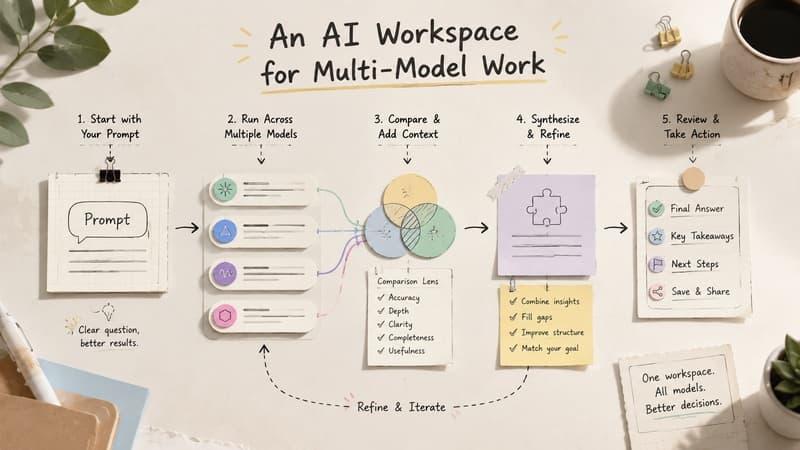
A multi-model AI workflow helps you use more than one AI model for the same task without turning the process into a mess. Instead of asking one assistant and hoping the first answer is enough, you assign each model a clear role, compare the results, and synthesize a stronger final output.
This workflow is useful for research, writing, coding, planning, summarization, and answer verification. The goal is not to use more models for its own sake. The goal is to get better judgment from a repeatable process.
What Is a Multi-Model AI Workflow?
A multi-model AI workflow is a structured process for routing prompts, tasks, and review steps across multiple AI models. One model may draft, another may critique, another may summarize, and another may help verify assumptions. The workflow becomes valuable when each step has a purpose.
If you are new to the idea, start with the Beginner's Guide to Multi-Model AI Platforms to understand how multi-model platforms differ from ordinary single-model chat tools.
Multi-Model AI Workflow Breakdown
Step 1: Define the task and success criteria
Write down what a good answer must include before you ask any model. For example, a research summary might need clear claims, uncertainty notes, practical next steps, and no unsupported statistics.
Step 2: Send the same base prompt to multiple models
Use one shared prompt so the comparison is fair. If each model receives a different instruction, you are comparing prompt quality rather than model fit.
Step 3: Compare strengths and gaps
Look for differences in structure, caution, reasoning, completeness, and usefulness. The best answer is often not the longest answer. It is the one that best matches the task.
Step 4: Ask for targeted revision
Take the strongest response and ask another model to critique it. This helps reveal missing assumptions, vague recommendations, or unsupported claims.
Step 5: Synthesize the final output
Combine the best parts into one answer, then do a final review against the original success criteria.
Checklist for a Reliable Multi-Model Workflow
- Use one clear base prompt across models.
- Separate drafting, critique, and synthesis into different steps.
- Keep a simple scoring rubric for recurring tasks.
- Flag claims that need human verification.
- Save prompts that consistently produce useful results.
- Review whether the workflow saves time after repeated use.
For research-heavy work, the article AI Research Workflow: From Questions to Insights gives a more focused example of turning questions into reviewed outputs.
Common Mistakes to Avoid
Using multiple models without a decision rule
If every answer looks plausible, you need a way to decide what counts as better. Use criteria such as accuracy, completeness, clarity, evidence needs, task fit, and revision effort.
Letting the workflow become slower than the task
Multi-model review is not needed for every small question. Use it when the answer affects research quality, business decisions, public writing, code review, or team planning.
Assuming agreement means correctness
When two models agree, the answer may still need verification. Multi-model comparison improves judgment, but it does not replace human review for important facts.
How Meshub.ai Helps
Meshub.ai helps users discover AI tools, compare multi-model platforms, and explore workflows that depend on more than one assistant. That makes it useful when building a multi-model AI workflow because the process depends on choosing tools that match the task, not just picking the most familiar chat interface.
Users comparing workflow maturity can also read What to Compare When AI Usage Scales to think through review, switching cost, and long-term fit.
FAQ
What is the best way to use multiple AI models?
The best approach is to give each model a role. Use one model for drafting, another for critique, and another for synthesis or verification when the task is important.
Does a multi-model AI workflow always improve answers?
Not always. It improves answers when the task benefits from comparison, review, and revision. For simple questions, one model may be enough.
How do I compare AI responses fairly?
Use the same base prompt, define success criteria before testing, and compare each response against the same rubric.
Can a multi-model workflow reduce hallucinations?
It can help reveal weak claims and contradictions, but important facts still need human verification or trusted external references.
Meshub.ai helps users discover, compare, and explore the best AI tools and multi-model platforms in one place.