Published May 24, 2026 in Meshub.ai
What To Compare In Enterprise AI Deployment Now

Share


Key Takeaways
- Enterprise AI deployment is now a control question, not only a capability question.
- Hybrid and on premises access matters more as AI moves closer to important systems and data.
- Security response and remediation capacity now belong inside product comparison.
On May 18, 2026, OpenAI and Dell said Codex would move deeper into hybrid and on premises enterprise environments. On May 22, 2026, Anthropic said Project Glasswing and its partners had used Claude Mythos Preview to find more than ten thousand high or critical severity vulnerabilities across systemically important software. Together, these updates point to the same conclusion: enterprise AI value rises when systems get closer to critical work, but so does the need for deployment control and operational trust.
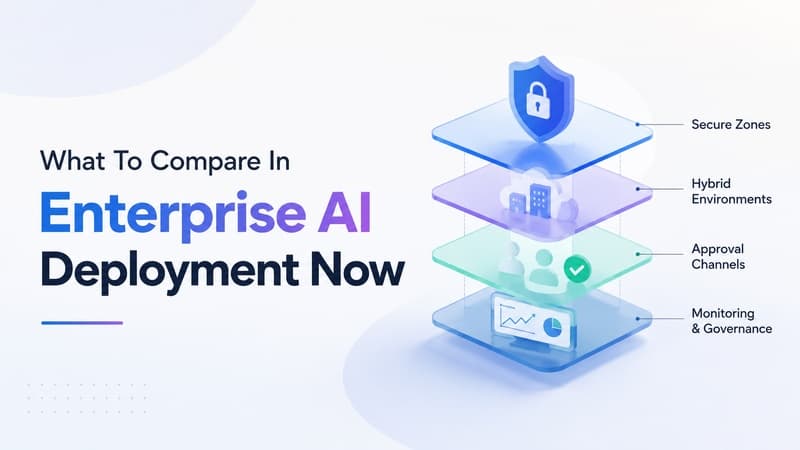
1. Compare Where The AI Can Run
Deployment location is no longer a minor technical detail. It shapes which teams can adopt the product and how much useful context the system can safely access.
Compare:
- public cloud only deployment
- hybrid deployment across internal systems
- on premises options for higher control environments
- how clearly the product separates data zones and execution paths
If AI cannot meet the environment where the work already lives, adoption tends to stall.
2. Compare Security As An Operating Function
The security question is no longer only whether a vendor has a safety page. The more important question is how the product behaves when it touches real repositories, workflows, and infrastructure.
Teams should test:
- what is visible before the system acts
- how approvals work in higher risk flows
- how activity can be reviewed after the fact
- whether operators can interrupt or redirect a run safely
Those checks matter more than polished demos.
3. Compare Remediation Reality, Not Only Detection
One important signal from the latest security work is that discovery speed is rising faster than human remediation capacity. That changes how buyers should compare products.
Ask:
- does the system only surface issues, or does it help structure the next action
- can another operator pick up the work without reading everything from the start
- does the output stay useful after export into tickets, documents, or review queues
- can teams keep the workflow understandable when volume increases
This is one reason discovery and comparison layers like Meshub.ai matter more as deployment choices get more complex.
4. Compare Governance Without Freezing The Team
Good enterprise AI products do not force teams to choose between speed and control. They make control part of the workflow.
Look for:
- approval checkpoints before external or high impact actions
- clear role boundaries between reviewers and operators
- portable outputs that survive tool changes later
- support for multi model strategies when one product is not enough
Readers calibrating platform tradeoffs can also revisit Best AI Models in 2026 before narrowing a deployment path.
5. Compare Enterprise Readiness By Continuity
A product may look impressive in a short trial and still fail at enterprise scale if work cannot continue cleanly across time, people, and devices.
That is why continuity still matters:
- tasks should stay understandable after interruption
- status should remain visible without digging through transcripts
- handoffs should preserve both context and accountability
- the workflow should remain useful if one model or connector changes later
For a workflow focused frame, How to Build Voice Ready AI Workflows is a good follow on read.
Bottom Line
Enterprise AI deployment should now be compared on environment fit, security behavior, remediation support, governance, and continuity together. Model quality still matters, but it is no longer enough on its own.
FAQ
Why is deployment location such a big issue now
Because AI systems are moving closer to critical data and workflows, which makes environment fit part of product value.
What is the biggest comparison mistake enterprises make
They focus on model output quality without testing how the system behaves in real operating environments.
Why does remediation support matter so much
Because detection is becoming easier for AI systems, while verification, routing, and patch work still depend on human capacity.
How does Meshub.ai help with enterprise AI evaluation
Meshub.ai helps users compare AI tools and multi model platforms in one place so deployment tradeoffs are easier to understand before rollout.
Meshub.ai helps users discover, compare, and explore the best AI tools and multi-model platforms in one place.