Published February 09, 2026 in Meshub.ai
The Ultimate Guide to Prompt Engineering: How to Talk to AI Effectively

Share


Introduction: Why Input Quality Determines Output Quality
If you’ve ever used a generative AI tool and felt disappointed by the response, you’re not alone.
Many new users assume AI will automatically understand what they want. In reality, AI follows a very simple rule:
Garbage in, garbage out.
The quality of an AI’s output depends almost entirely on the quality of your input — also known as the prompt. This is why learning prompt engineering is one of the most valuable skills for anyone using AI today.
The good news? You don’t need to be a developer or technical expert. With clear instructions, you can master prompt engineering.
What Is Prompt Engineering?
Prompt engineering is the practice of writing clear, structured instructions that help AI generate accurate, relevant, and useful responses.
You don’t need to be technical. If you can clearly explain what you want, you can master this skill.
This guide will show you how to write AI prompts that actually work — even if you’re a complete beginner.
The Simple Prompt Formula Every Beginner Should Use
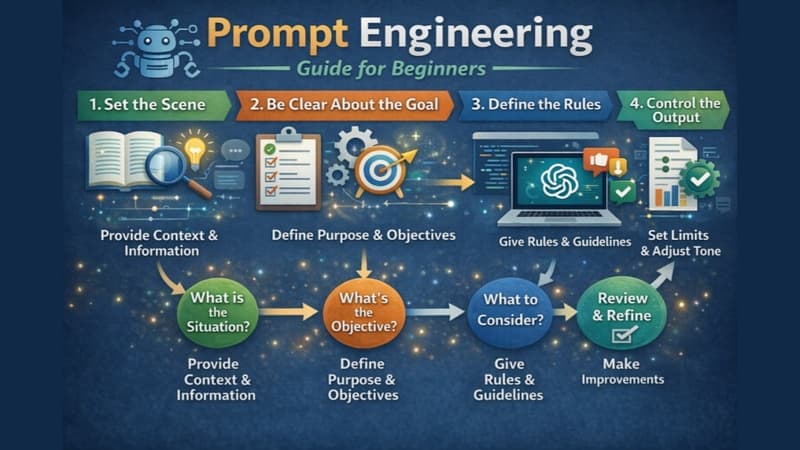
A reliable framework for writing effective AI prompts is:
Context + Task + Constraints + Format
1. Context: Set the Scene
Context tells AI who you are and what situation you’re in.
Example:
“I’m a beginner content creator writing blog posts for a general audience.”
2. Task: Be Clear About the Goal
Clearly state what you want the AI to do.
Example:
“Write a blog post explaining what generative AI is.”
3. Constraints: Define the Rules
Constraints help guide tone, length, and complexity.
Common constraints include:
- Target audience
- Word count
- Language level
- SEO requirements
Example:
“Use simple language, avoid technical jargon, and keep it under 1,200 words.”
4. Format: Control the Output
Formatting instructions make content easier to use immediately.
Example:
“Use clear headings and bullet points.”
Bad Prompt vs. Good Prompt
❌ Bad Prompt
“Write about AI prompts.”
Why it fails:
- No context
- No target audience
- No structure
✅ Good Prompt
“Write a beginner-friendly guide on how to write AI prompts. The target audience is new users with no technical background. Use simple language and clear headings.”
Result: Clearer, more relevant, and immediately usable content.
10 Proven Prompting Strategies to Get Better AI Results
1. Be Explicit, Not Clever
AI works best with direct instructions.
2. Always Define the Audience
Tell AI who it’s writing for: beginners, professionals, or the general public.
3. Use Role-Playing Prompts
Example: “Act as a marketing expert and review this landing page.”
4. Ask for Step-by-Step Explanations
This improves clarity for complex topics.
5. Request Multiple Options
Example: “Give me three headline variations.”
6. Set a Reading Level
Example: “Write at an 8th-grade reading level.”
7. Provide Reference Examples
Show AI what style or tone you prefer.
8. Break Big Tasks into Smaller Prompts
Outline first, then draft, then edit.
9. Let AI Ask Questions First
Example: “Ask clarifying questions before answering.”
10. Iterate and Refine
Prompting works best as a conversation.
Best AI Prompts for Beginners (Templates)
- Writing: “Write a beginner-friendly article about [topic] using simple language.”
- Learning: “Explain [concept] as if I have no prior knowledge.”
- Marketing: “Act as a marketing expert and suggest improvements.”
- Productivity: “Summarize this text into key bullet points.”
Why Prompt Engineering Matters
As AI tools become more powerful, the difference between average and great results comes down to one thing:
How well you communicate with AI.
Prompt engineering helps you get more accurate, useful, and goal-oriented responses — without needing better tools.
Call to Action: Try It Now
Open Meshub.ai and write your next prompt using this structure:
Context + Task + Constraints + Format
You’ll immediately notice better results.
Better prompts don’t require better AI — just better questions.