Published May 12, 2026 in Meshub.ai
Best AI Models in 2026: GPT-5.5 vs Claude Opus 4.7 vs DeepSeek V4 Pro

Share


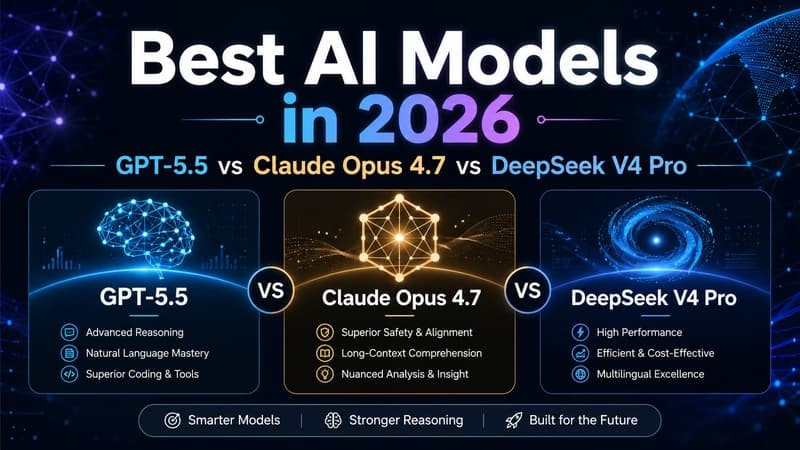
In 2026, choosing an AI model is no longer just about using the “smartest chatbot.” Different models now specialize in completely different tasks:
-
Some dominate coding
-
Some excel at writing
-
Some are optimized for long-context reasoning
-
Some are faster and cheaper
-
Some are better for multilingual workflows
That creates a new challenge for users:
Which AI model should you actually use?
To help users compare the latest frontier AI systems, Meshub.ai has officially launched support for:
-
GPT-5.5
-
Claude Opus 4.7
-
DeepSeek V4 Pro
-
Kimi K2.6
-
GLM 5.1
-
MiMo-V2.5-Pro
This guide compares their strengths, weaknesses, ideal use cases, and which model performs best for real-world workflows in 2026.
Which AI Model Is Best in 2026?
If you just want the short answer:
| Use Case | Best AI Model |
|---|---|
| Best Overall AI Model | GPT-5.5 |
| Best AI Model for Coding | DeepSeek V4 Pro |
| Best AI Model for Writing | Claude Opus 4.7 |
| Best AI Model for Long PDFs | Kimi K2.6 |
| Best Multilingual AI Model | GLM 5.1 |
| Best Fast Lightweight AI | MiMo-V2.5-Pro |
For most users, GPT-5.5 is currently the most balanced all-around model.
However:
-
Developers may prefer DeepSeek V4 Pro
-
Writers often prefer Claude Opus 4.7
-
Researchers handling large documents may prefer Kimi K2.6
Why AI Model Choice Matters More Than Ever
Back in 2024, most users only compared ChatGPT and Claude.
In 2026, the landscape is far more competitive.
Modern AI models now specialize in:
-
reasoning,
-
agent workflows,
-
long-context memory,
-
coding,
-
multilingual tasks,
-
creative writing,
-
and enterprise productivity.
This means the “best AI model” depends entirely on your workflow.
For example:
-
A software engineer may prioritize coding accuracy
-
A marketer may care more about writing quality
-
A researcher may need long-context understanding
-
A startup may optimize for cost and speed
That’s exactly why multi-model AI platforms are becoming more important.
Instead of forcing users into one ecosystem, Meshub.ai allows users to switch between different frontier AI models depending on the task.
AI Model Comparison Table (2026)
| Model | Reasoning | Coding | Writing | Speed | Best For |
|---|---|---|---|---|---|
| GPT-5.5 | ⭐⭐⭐⭐⭐ | ⭐⭐⭐⭐⭐ | ⭐⭐⭐⭐☆ | ⭐⭐⭐⭐ | Overall balance |
| Claude Opus 4.7 | ⭐⭐⭐⭐☆ | ⭐⭐⭐⭐ | ⭐⭐⭐⭐⭐ | ⭐⭐⭐ | Writing & creativity |
| DeepSeek V4 Pro | ⭐⭐⭐⭐☆ | ⭐⭐⭐⭐⭐ | ⭐⭐⭐ | ⭐⭐⭐⭐⭐ | Coding & technical work |
| Kimi K2.6 | ⭐⭐⭐⭐ | ⭐⭐⭐⭐ | ⭐⭐⭐⭐ | ⭐⭐⭐ | Long-context workflows |
| GLM 5.1 | ⭐⭐⭐ | ⭐⭐⭐⭐ | ⭐⭐⭐ | ⭐⭐⭐⭐⭐ | Multilingual AI |
| MiMo-V2.5-Pro | ⭐⭐⭐ | ⭐⭐⭐ | ⭐⭐⭐ | ⭐⭐⭐⭐⭐ | Fast lightweight usage |
1. GPT-5.5 — The Best Overall AI Model
GPT-5.5 is currently one of the strongest all-around AI systems available.
Compared with previous generations, GPT-5.5 offers:
-
better reasoning,
-
stronger coding performance,
-
more reliable instruction following,
-
improved memory handling,
-
and more stable long conversations.
It also performs extremely well in agent-style workflows where AI needs to plan multiple steps.
Best For
-
Research
-
Coding
-
AI agents
-
Productivity workflows
-
SEO and GEO content
-
Business automation
Strengths
GPT-5.5 is one of the few models that performs consistently well across nearly every category.
If you only want one AI model in 2026, this is probably the safest choice overall.
Weaknesses
-
Premium pricing in some ecosystems
-
Slightly slower than lightweight models on simple tasks
2. Claude Opus 4.7 — The Best AI Model for Writing
Claude Opus 4.7 continues to dominate long-form writing and creative workflows.
Many users describe Claude as:
-
more natural,
-
more thoughtful,
-
and more human-like
than most competing models.
Best For
-
Blog writing
-
Editing
-
Brand voice
-
Creative ideation
-
Long-form storytelling
-
Strategy documents
Why Writers Prefer Claude
Claude is exceptionally good at:
-
nuanced tone,
-
structured explanations,
-
and polished first drafts.
For marketers, creators, founders, and agencies, Claude often produces the most “publish-ready” content.
Weaknesses
-
Can become overly verbose
-
Coding performance is solid, but not always DeepSeek-level
3. DeepSeek V4 Pro — The Best AI Model for Coding
DeepSeek V4 Pro has become one of the most respected coding-focused AI systems in 2026.
Its biggest advantages include:
-
strong technical reasoning,
-
fast inference,
-
concise responses,
-
and lower operational costs.
Best For
-
Software engineering
-
Debugging
-
SQL generation
-
Automation scripts
-
API integration
-
Technical workflows
Why Developers Like It
DeepSeek models often produce:
-
cleaner code,
-
faster implementations,
-
and more direct answers
than many general-purpose models.
For startups building AI-powered products, DeepSeek is especially attractive because of its cost efficiency.
Weaknesses
-
Creative writing quality is weaker than Claude
-
Conversational tone can feel less polished
4. Kimi K2.6 — The Long Context Specialist
Kimi K2.6 stands out because of its excellent long-context capabilities.
Long-context AI is becoming increasingly important in 2026 because users often work with:
-
huge PDFs,
-
research papers,
-
meeting transcripts,
-
legal documents,
-
and enterprise knowledge bases.
Best For
-
Research workflows
-
Long PDF analysis
-
Knowledge management
-
Multi-document reasoning
-
Academic tasks
Why It Matters
Kimi performs especially well when users need AI to remember information across extremely large inputs.
That makes it useful for:
-
researchers,
-
analysts,
-
consultants,
-
and enterprise teams.
Weaknesses
-
Sometimes slower with massive prompts
-
Writing quality is less refined than Claude
5. GLM 5.1 — The Multilingual AI Leader
GLM 5.1 is rapidly becoming a strong option for multilingual AI workflows.
Its biggest strengths are:
-
Chinese + English performance,
-
efficient deployment,
-
and scalable multilingual usage.
Best For
-
Translation
-
Localization
-
International businesses
-
Global AI products
-
Cross-language workflows
Why Global Teams Care
As AI adoption becomes increasingly international, multilingual performance matters more than benchmark scores alone.
GLM 5.1 is especially useful for businesses serving multiple language markets.
Weaknesses
-
Smaller ecosystem compared with GPT or Claude
-
Less dominant in frontier reasoning tasks
6. MiMo-V2.5-Pro — Fast, Lightweight, and Efficient
MiMo-V2.5-Pro focuses heavily on speed and responsiveness.
Instead of competing purely on model size, MiMo emphasizes:
-
fast interactions,
-
lower latency,
-
lightweight deployment,
-
and practical daily usage.
Best For
-
Everyday AI chats
-
Quick brainstorming
-
Mobile AI experiences
-
Fast summarization
-
Lightweight workflows
Strengths
MiMo feels responsive and efficient for users who prioritize speed over deep reasoning.
It works particularly well for:
-
quick tasks,
-
lightweight productivity,
-
and rapid interactions.
Weaknesses
-
Less capable on advanced reasoning tasks
-
Weaker technical depth than GPT-5.5 or DeepSeek
Which AI Model Should You Actually Use?
Here’s the practical answer.
If you're a developer
Use:
-
DeepSeek V4 Pro for coding
-
GPT-5.5 for architecture planning and reasoning
If you're a content creator
Use:
-
Claude Opus 4.7 for writing
-
GPT-5.5 for research and SEO workflows
If you work with long reports or PDFs
Use:
-
Kimi K2.6
If you run multilingual workflows
Use:
-
GLM 5.1
If you want fast lightweight AI
Use:
-
MiMo-V2.5-Pro
Why Multi-Model AI Platforms Are the Future
The era of using one AI model for everything is ending.
Modern AI workflows increasingly combine multiple systems:
-
GPT-5.5 for reasoning
-
DeepSeek for coding
-
Claude for writing
-
Kimi for large documents
-
GLM for multilingual output
-
MiMo for fast daily tasks
That’s why multi-model AI platforms are growing rapidly.
Instead of switching between multiple AI apps, users can compare frontier AI systems directly inside Meshub.ai.
This is especially useful for:
-
developers,
-
content creators,
-
startups,
-
SEO professionals,
-
researchers,
-
and business teams.
Our Take
If you only want one AI model in 2026, GPT-5.5 is probably the safest all-around choice.
However:
-
Claude Opus 4.7 still leads in writing quality
-
DeepSeek V4 Pro remains exceptional for developers
-
Kimi K2.6 dominates long-context workflows
-
GLM 5.1 is highly attractive for multilingual products
The smartest AI workflow in 2026 is no longer choosing one model forever.
It’s choosing the right model for the right task.
Try the Latest AI Models on Meshub.ai
With the launch of:
-
GPT-5.5
-
Claude Opus 4.7
-
DeepSeek V4 Pro
-
Kimi K2.6
-
GLM 5.1
-
MiMo-V2.5-Pro
Meshub.ai is becoming a true multi-model AI workspace for modern users.
Instead of juggling multiple subscriptions and AI apps, you can compare leading frontier models in one place and choose the best AI system for every workflow.
FAQ
Which AI model is best for coding in 2026?
DeepSeek V4 Pro is currently one of the strongest AI models for coding, debugging, and technical workflows.
Is Claude better than GPT-5.5 for writing?
Claude Opus 4.7 usually produces more natural and polished long-form writing, while GPT-5.5 offers stronger overall reasoning.
Which AI model is best for long PDFs?
Kimi K2.6 performs especially well in long-context workflows and large document analysis.
What is the best all-around AI model in 2026?
For most users, GPT-5.5 is currently the most balanced AI model overall.
Which AI model is best for multilingual workflows?
GLM 5.1 is becoming a strong option for multilingual AI tasks and global business workflows.