Published June 22, 2026 in Meshub.ai
AI Answer Reliability: How to Trust AI Responses Before You Use Them

Share


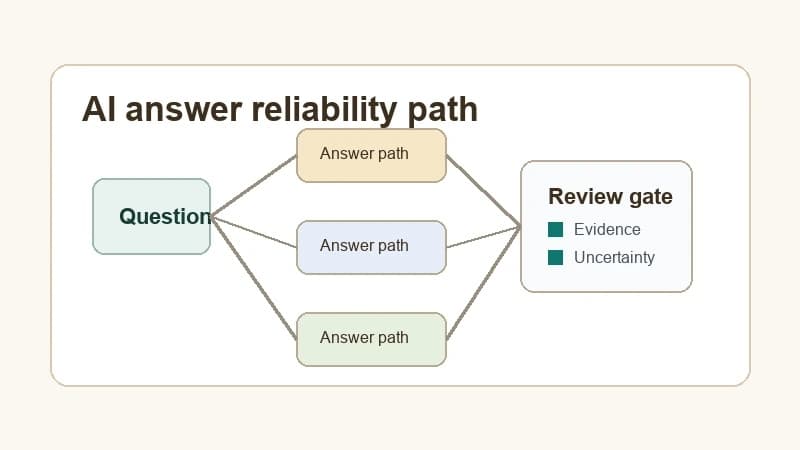
AI answer reliability is the discipline of checking whether an AI response is useful, grounded, complete, and safe enough for the job you want it to do. It is not the same as asking whether an AI answer sounds confident. In many workflows, confidence is cheap. Reliability comes from context, comparison, verification, and human judgment.
As more people use AI assistants for research, writing, coding, planning, summarizing, and decision support, answer reliability becomes a practical work issue. A model can produce an elegant paragraph that misses a constraint. It can summarize a document while dropping an important exception. It can recommend a plan without showing assumptions. It can answer a question in a way that is directionally helpful but still not ready for publication, customer communication, legal review, financial decisions, or product changes.
This guide explains what AI answer reliability means, why it matters, and how to improve it with a repeatable review workflow. If your team already compares AI tools, reliability should become one of the core evaluation criteria alongside speed, cost, usability, and model access.
What Is AI Answer Reliability?
AI answer reliability means the output can be trusted for a defined purpose after appropriate review. It is not a claim that the answer is perfect. It is a judgment that the answer is sufficiently accurate, complete, transparent, and usable for the next step. The “next step” matters because reliability is contextual. A brainstormed headline has a lower reliability bar than a regulatory summary. A draft outline has a lower bar than a customer-facing answer. A private research note has a lower bar than a product decision memo.
A reliable AI answer usually has four qualities. First, it addresses the actual user intent rather than a nearby topic. Second, it makes assumptions visible instead of hiding them behind confident wording. Third, it separates known information from uncertainty. Fourth, it is easy for a human to verify, edit, or reject. These qualities are easier to assess when you compare multiple answers rather than accepting the first response.
Why AI Answer Reliability Matters
AI assistants are useful because they reduce friction. They can generate first drafts, summarize dense text, compare options, and create starting points. But friction reduction can become risky when users skip review. The faster an answer arrives, the easier it is to treat the answer as finished. That is where reliability problems enter daily work.
For individuals, unreliable answers waste time because they create cleanup work later. For teams, unreliable answers create coordination problems because people build on output that may not have been checked. For companies, unreliable answers can affect customer trust, brand quality, product decisions, and operational consistency. This does not mean teams should avoid AI. It means they need a repeatable way to decide when an answer is ready and when it needs another pass.
The Meshub article on why compare AI models explains this broader habit: model disagreement can be a signal, not a nuisance. It shows where the answer needs better evidence, more context, or a human decision.
Key Points for More Reliable AI Answers
- Reliability is task-specific. The standard for a creative draft is different from the standard for a factual brief.
- Prompt quality affects reliability. Vague prompts often produce answers that sound complete while missing essential constraints.
- Comparison reveals blind spots. Running one prompt across multiple models can expose assumptions and missing details.
- Verification should be planned. Do not wait until the final answer to ask whether claims need checking.
- Human judgment stays central. AI can help generate and compare, but the user owns the decision to use the output.
A Practical Workflow for Checking AI Answer Reliability
1. Define the answer’s job
Start by naming the output’s purpose. Is it a draft, a summary, a recommendation, a checklist, a comparison table, a coding suggestion, or a decision memo? Reliability improves when the model knows what the answer is for. Include audience, stakes, format, constraints, and what should be excluded. A prompt that says “summarize this” is weaker than a prompt that says “summarize this for a product manager deciding whether to prioritize the issue, and separate facts from assumptions.”
2. Ask for uncertainty and assumptions
Reliable answers do not pretend that missing information is available. Ask the model to list assumptions, uncertainty, and verification needs. This simple instruction changes the output from a polished answer into a reviewable answer. It also helps you spot where the model may be filling gaps.
3. Compare at least two model responses
One model may miss a risk that another model catches. One may structure the answer better. One may be too broad, while another may be too narrow. Comparing responses does not automatically reveal the truth, but it helps reveal where your attention should go. Meshub’s guide to using one prompt across multiple models shows how this can become a repeatable workflow rather than a manual copy-paste routine.
4. Score before synthesis
Before combining answers, score them independently. Use criteria such as task alignment, completeness, factual caution, specificity, structure, and actionability. If an answer is strong in structure but weak in evidence, keep the structure and verify the claims. If an answer is cautious but incomplete, use it as a risk checklist rather than a final response.
5. Verify claims that affect decisions
Not every sentence needs the same level of verification. Focus on claims that change a decision, affect a user, describe a third-party product, cite a number, mention timing, or create operational risk. For uncertain claims, ask for source requirements or mark them for human review. In high-stakes contexts, use authoritative sources and domain experts rather than relying only on model consensus.
Practical Examples
In research work, AI answer reliability may mean checking whether the model distinguishes source facts from interpretation. A useful answer might summarize the topic clearly, but a reliable answer also tells you what evidence is missing. In writing work, reliability may mean preserving the intended audience and not inventing unsupported benefits. In coding work, reliability may mean explaining assumptions, edge cases, and tests rather than only producing a plausible snippet.
In product work, reliability may mean comparing multiple suggestions before changing a roadmap. If one model recommends a feature because it sounds strategic, and another model highlights maintenance cost or onboarding risk, the comparison helps the team make a better decision. For a broader model-selection habit, Meshub’s guide to AI model comparison tools provides a useful companion framework.
How Meshub.ai Helps
Meshub.ai helps improve AI answer reliability by making comparison easier. Instead of treating one model response as the default answer, users can test the same prompt across multiple AI models, review differences, and identify the answer that best fits the task. This supports a more reliable workflow because the review step becomes visible.
Meshub is especially helpful when you need to compare tone, structure, assumptions, and factual caution. A marketer can compare positioning drafts. A researcher can compare summaries. A founder can compare decision memos. A support lead can compare customer response options. The value is not simply that more models produce more text. The value is that side-by-side answers create a better review surface.
When teams make AI comparison part of their routine, they also create a shared language for quality. Instead of saying “the AI answer was good,” they can say the answer was complete, cautious, well structured, but still needed source verification. That is a much stronger basis for using AI in real work.
How to Turn Reliability Into a Team Habit
Start with a lightweight rubric. Define what a reliable answer must include for your common workflows. For research, require assumptions and verification notes. For writing, require audience fit and unsupported-claim checks. For coding, require edge cases and test suggestions. For decisions, require tradeoffs and confidence level. Keep the rubric short enough that people will actually use it.
Then standardize prompts for recurring tasks. A reusable prompt template reduces randomness and makes outputs easier to compare. Finally, save examples of strong and weak outputs. This creates internal judgment over time. AI answer reliability improves when teams stop treating each prompt as a one-off conversation and start treating AI output as work that can be reviewed, compared, and improved.
FAQ
What does AI answer reliability mean?
AI answer reliability means an AI response is accurate, complete, transparent, and usable enough for a specific purpose after the right level of review.
How can I make AI answers more reliable?
Use clearer prompts, ask for assumptions, compare multiple model responses, score answers before synthesis, and verify claims that affect decisions or user-facing work.
Does comparing AI models guarantee a correct answer?
No. Comparing models does not guarantee correctness, but it can reveal disagreements, missing details, and assumptions that should be checked before you use the answer.
Why do AI models give different answers?
Different models may interpret the prompt, context, constraints, and desired format differently. Differences can also come from training, model behavior, and how each assistant handles uncertainty.
When should I verify an AI answer manually?
Verify manually when the answer affects money, safety, legal or medical interpretation, customer communication, product decisions, technical implementation, or any claim that depends on current facts.
Use Meshub.ai to compare AI responses side by side and build a more reliable review workflow before you publish, decide, or ship.